

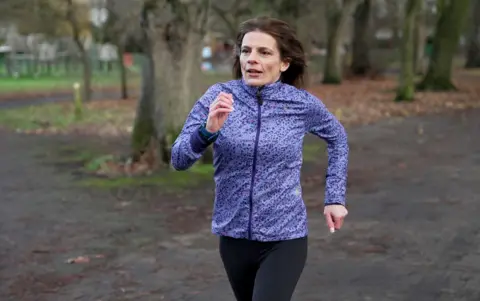
An atmosphere of nervous excitement. I can see the chilled vapour coming from my competitors as they perform the "pre-race" wiggle on the start line.
A quick flick of the hips.
I'm at my local weekly parkrun event and I'm focused. It's almost time...
Wait a second. I have to sort my tracker. As does the guy alongside me.
The person waiting expresses impatience. I refuse to go until… yes! Connection established, I'm off.
In the mele, it's hard to find a wrist without a wearable on it. And this isn't only us participants who rely on them.
We're witnessing a thriving, multi-billion pound sector. Names like Apple Watch are prevalent, each with an extensive array of diverse versions to suit a range of budgets. Depending on how advanced the device you choose, prices can range from a hundred pounds to a small fortune.
"It drives me insane, I can't relax."
"It provides solace… It's like a supporter supporting me."
"I wish it wouldn't say I've had a restless night."
Just some of the responses I've received from fellow smartwatch wearers when I question what they feel about theirs.
The Monitoring Conundrum
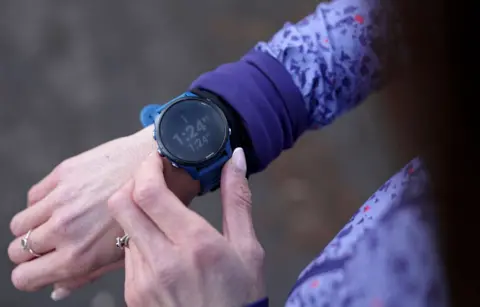
My current opinion on mine? Right now, frustrating. It's telling me I'm off pace, making me wonder whether the trees I'm passing under are blocking my location tracking.
A vast number of us attach these little devices onto our wrists and use them 24/7, ostensibly unconcerned with the fact they're continuously recording us.
A distant memory are the days when we depended on them exclusively to give us an rough count of our pedometer reading. Today, they can analyse our sleep quality, stress levels, oxygen saturation, our VO2 max.
It's a challenge to find a physical metric they aren't designed to measure.
But do they do what they say they do? And are the statistics we obsess over a true reflection of reality? Do they boost our overall health, or do the multitude of measurements and motivational messages just add to our sense of overwhelm?

A Love-Hate Relationship
"I find myself getting a bit preoccupied with mine," one user confesses.
While she loves how her device tracks her runs, she finds some of its other functions "daunting" at times - a feeling first discovered during a pregnancy.
Before she realised she could adjust the settings, her smartwatch constantly alerted her she was being insufficiently productive enough. In a new phase, the watch frequently reports her she's had a restless night.
"I am caring for a young baby, I don't need to be notified my sleep was poor," she says. "I'm acutely aware perfectly well."
Couldn't she just take it off?
"I suppose I could, theoretically, but I've got this push-pull dynamic with it," she explains. "I value it for its exercise data, but I'm unsure whether the additional features it can now do is maybe overkill for me."
The Technology Behind the Tracking
Every device of smartwatch has its own novel way of tracking your health metrics and processing your data, but the vast bulk use detectors on the underside of the watch.
They commonly shine minute LED lights onto your skin which can monitor capillary action, identifying your heartbeat. More advanced devices analyse changes in the electrical current that flows through the skin to gauge your stress levels.
A Fine Balance
One expert says that for most people for smartwatches, it's a "difficult line" - while the rapidly advancing tech could actually prevent illness, "detecting disease before we notice anything", it could also turn us device users into the "anxious healthy".
He points out that some of the latest wearables can conduct tests like medical-grade monitoring, which continuously monitor how healthy the heart is. They can alert if someone is experiencing an irregular rhythm, where there is abnormal electrical activity in the heart causing an arrhythmia.
This does not necessarily indicate someone is imminently going to suffer a cardiac event, but it can give an advance notice they might be more at risk of a blood clot in the future.
But how to make sense of these numbers is complex. The expert fears that as additional features are incorporated, people may struggle to fully contextualise their data.
"I remain sceptical that the ability to monitor so many metrics is such a positive development," he says.
A professor focusing on patient behaviour echoes this sentiment. Research into the impact of wearable tech on a cohort of individuals with health issues suggested a noticeable percentage of those who were given devices to monitor their heart health experienced heightened worry and were "had a higher tendency to use doctor's time".
She observed a cycle with her patients - they spotted a concerning reading on their watch. They grew concerned. Their pulse rose. They got even more concerned. They re-examined the data, and their anxiety increased again.
"When people are presented with data about ourselves that we lack context for then, naturally, we are going to become concerned," the psychologist says. "We monitor, we re-check - it becomes a feedback loop."


